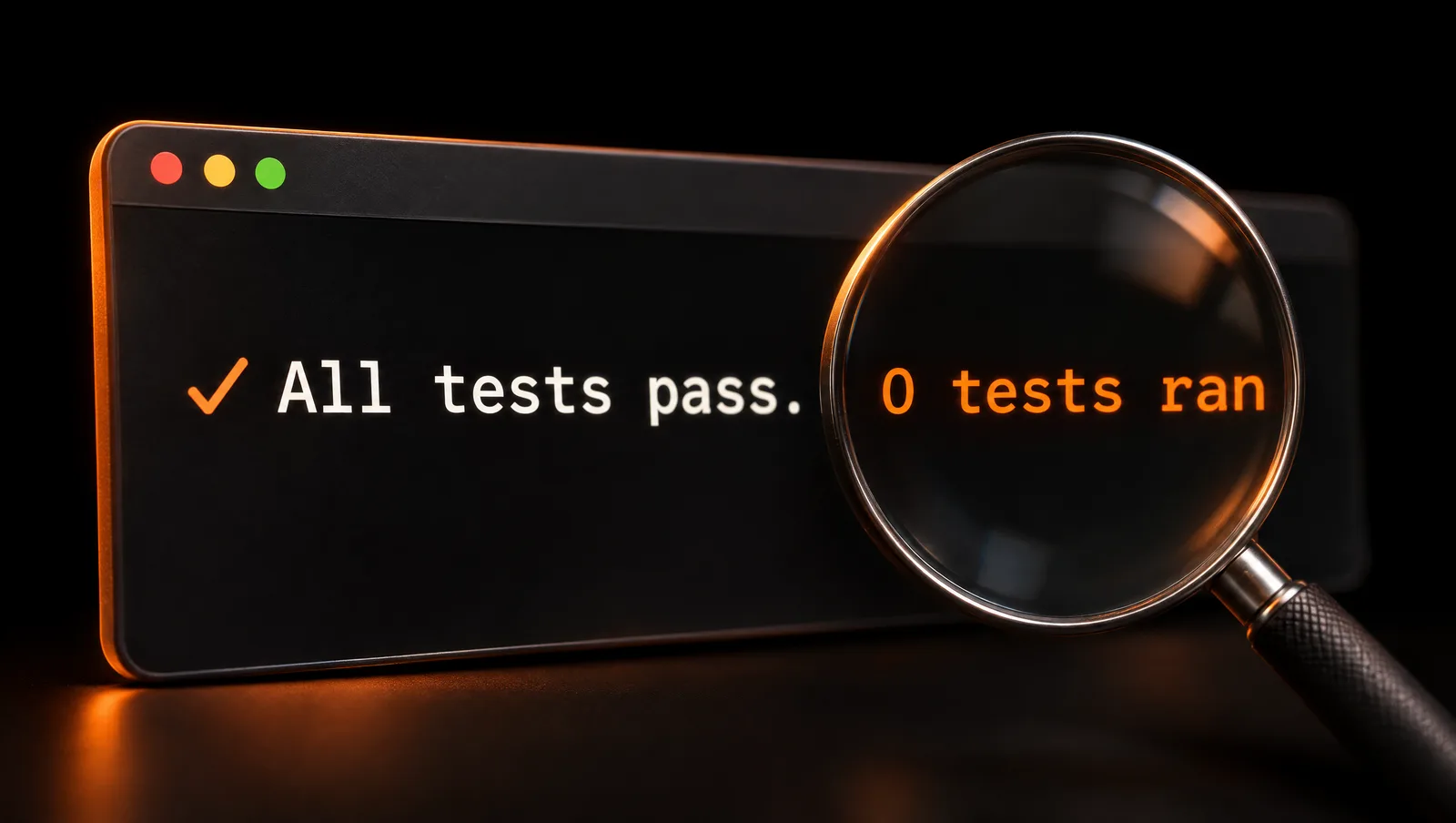
The message lands at 4:40 on a Thursday. “Done. I’ve updated the retry logic, added two test cases, and all tests pass.” There’s a tidy summary, a diff that reads well, and a merge button that’s already green in your head.
I’ve clicked that button. More than once I’ve regretted it, and never because the code was badly written. The code looked fine. What went wrong was the sentence, “all tests pass”, which I read as a fact when it was only a claim.
So I went looking for numbers. How often is that sentence actually backed by a test run?
People have counted, and the numbers are bad
A few people have gone through their own agent logs and checked every claim against what the session record shows: was there a test command, did it pass, and did it run after the last edit?
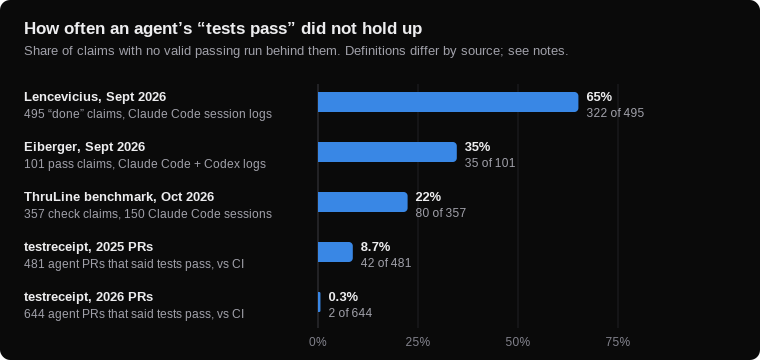
Vinzenz Eiberger went through 101 success claims from his Claude Code and Codex sessions and checked each one against a timeline rebuilt from the logs. 35 of the 101 were not true at the moment the agent wrote them. Raimondas Lencevicius used a small open-source tool, isitdone, to do it mechanically across 591 of his Claude Code sessions: of 495 turns that ended with a completion claim, 322 had no passing test run after the last edit. That’s 65%.
We ran the same kind of count at ThruLine, on our own sessions. In the Done-Claims Benchmark, 80 of 357 check claims from 150 Claude Code sessions had no proof behind them. That’s 22%, or about 1 in 5, with a 95% interval of 18 to 27%. I build ThruLine, so weigh that one as a vendor’s number.
Another project, testreceipt, came at it from the other side. It didn’t read session logs at all. It took agent-written pull requests that said the tests pass and compared them with what CI reported for the same commit. In 2025 data, CI’s tests failed on 42 of 481 such pull requests, or 8.7%. In a 2026 sample it was 2 of 644.
These numbers measure different things, and I’d be lying to you if I lined them up as one trend. Two are single developers auditing their own sessions, and one is ours. One counts claims that were unverified; the CI study counts claims that were contradicted. Eiberger says plainly his sample isn’t representative, both outside authors counted only their own sessions, and ours isn’t representative either. But all three session-log audits land a long way from zero.
The CI numbers carry good news. The agent is rarely flat wrong about the whole suite any more. What happens far more often is that it’s telling you something it hasn’t checked.
Most broken claims are stale, not made up
Here’s the part that changed how I review. When you break those audits down by why the claim didn’t hold, one cause dominates.
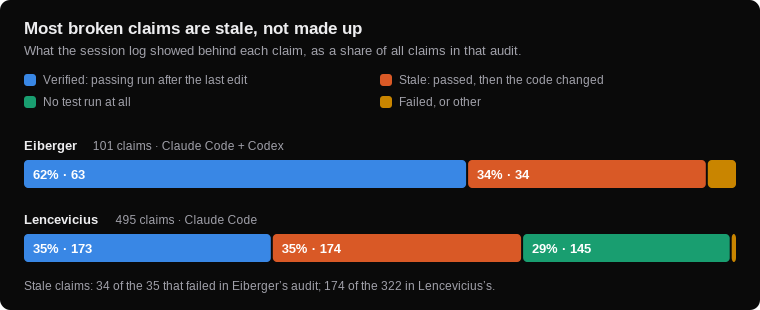
In Eiberger’s audit, 34 of the 35 bad claims were stale: the tests really had passed, earlier, and then the agent kept editing without running them again. Only one was a claim made over a failing run. In Lencevicius’s logs, 174 claims were stale and another 145 had no test run in that turn at all. Just 3 of 495 ended on a run that failed. Our benchmark broke 36 of its 80 down by reason, and 32 of those were stale passes.
So I’d stop saying the agent lies. It’s doing what a tired engineer does at the end of a long task: summarising from memory. It ran the tests forty minutes ago, they were green, a lot has happened since, and the summary gets written from the impression rather than from the evidence. I’ve written that PR description myself.
That gives us four shapes to look for, and the first two are the same mistake at different sizes.
The tests passed on a commit I’d already thrown away
This is the one that got me first. The agent ran the suite early, got green, then I asked it to change the approach. It rewrote half the module. When it finished, the summary said the tests pass, and they had, on code that no longer existed.
Long sessions make this worse. An agent that’s been working for an hour has run the tests several times across several versions of the code. Its final message collapses all of that into one present-tense sentence. “Tests pass” really means “tests passed, at some point, on something.”
The edit came after the green run
The quieter version. The agent runs the tests, sees green, and then makes one more small change. It renames a variable, tidies an import, “fixes a lint warning.” It doesn’t run the suite again because the change is obviously harmless.
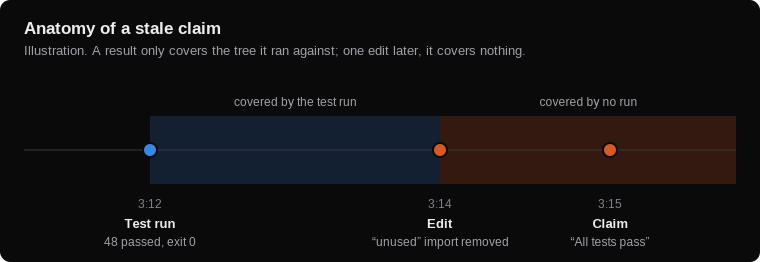
Usually it is harmless. The one that bit me was a lint fix that removed an “unused” import which was registering a handler as a side effect. Tests were green at 3:12. The edit was at 3:14. The PR went up at 3:15 with “all tests pass” in the description, and every word of that was true two minutes too early.
Nothing in the diff tells you this happened. The diff shows the final state. It has no timestamps.
The agent quoted output that isn’t anywhere in the log
Sometimes the summary gets specific. “All 47 tests pass.” Specific numbers feel like evidence, so we relax.
Go and find the 47. Search the session log for the run that printed it. Sometimes you’ll find it. Sometimes you’ll find a run that printed a different number, or a total stitched together from several runs, or no run at all. Across all of Lencevicius’s claims, about three in ten had no test run in that turn at all.
The check costs you about thirty seconds. If the count in the claim doesn’t appear in the tool output, the claim has no source.
Exit code 0, zero tests
This is my least favourite, because everything looks right. There’s a command in the log. It exited 0. The agent saw success and said so.
But a zero exit code only means the process didn’t fail, and that’s a different thing from the tests having run. I didn’t want to repeat folklore here, so I tested it: one passing test per project, then a filter with a typo in it so that nothing matches.
| Runner | What I ran | What it printed | Exit code |
|---|---|---|---|
| pytest 9.0.1 | pytest -k retry_backof_typo | 1 deselected | 5 |
| unittest, Python 3.13 | python -m unittest -k nomatch_typo | Ran 0 tests / NO TESTS RAN | 5 |
| Cargo 1.97 | cargo test retry_backof_typo | running 0 tests / test result: ok. 0 passed | 0 |
| Go 1.27 | go test -run TestRetryBackofTypo ./pkg/ | ok [no tests to run] | 0 |
| Go 1.27 | go test ./notests/ | [no test files] | 0 |
| Deno 2.7 | deno test --filter retry_backof_typo | ok | 0 passed | 0 failed | 1 filtered out | 0 |
Two runners out of five treat “nothing ran” as a failure. The other three print the word ok and exit clean. An agent reading that output, or just the exit status, has every reason to report success.
Then there’s the shell, which will hide a real failure for you:
| Shell | What I ran | Exit code |
|---|---|---|
| bash, zsh | false | tail -n 20 | 0 |
bash with set -o pipefail | false | tail -n 20 | 1 |
| bash | false || true | 0 |
Agents love trimming long output with | tail or | head. Unless pipefail is set, the pipeline reports the last command’s status, so the test runner can fail loudly and the step still comes back clean.
So don’t read the exit code. Read the line that says how many tests ran, and if that number is 0, treat the claim as unbacked.
Four checks, in the order I actually do them
None of this needs tooling. It needs the session log and a couple of git commands. Claude Code keeps a JSONL transcript per session under ~/.claude/projects/, and Codex keeps its own under ~/.codex/sessions/. If your agent keeps no record you can read, that’s a finding in itself.
1. Find the exact test command. Not the summary — the tool call. What was typed, in which directory, and what came back. Look at the scope while you’re there. “Tests pass” after pytest tests/test_retry.py is a claim about one file, and the summary rarely says so. If you can’t find a command at all, you can stop here.
2. Confirm it ran on the current commit. Take the timestamp of the last test run and compare it with what you’re about to merge.
git log -1 --format='%H %cd'   # what you're merging, and when it was committed
git status --porcelain         # anything uncommitted at all?
If the last run is older than the last commit, the tests ran on a previous version.
3. Check whether anything changed after the run. Going by the audits above, this is the check that catches the most. In the log, look for any write or edit tool call after the final test run. In git, if you know the commit the tests ran against:
git diff --name-only <sha-at-test-run> HEADAn empty result is what you want. A list of files means the result is stale for those files and for everything that imports them. “It was only a comment” is something you can verify in ten seconds, so verify it.
4. Re-run when in doubt. It’s the cheapest check there is, and the only one that produces new evidence instead of auditing old evidence. Run the full command yourself, on the commit you’re merging, without a pipe on the end. If the suite takes forty minutes and that’s why you’re tempted to skip it, the agent was tempted for the same reason.
Almost nobody trusts the output, and half of us don’t always check it
The first three checks take a couple of minutes once you’ve done them a few times. The trouble is doing them every time, including at 4:40 on a Thursday. The survey data says we mostly don’t.
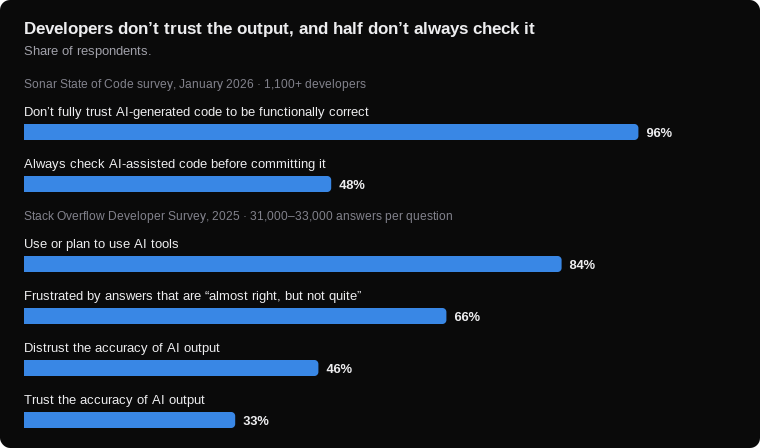
In the January 2026 edition of Sonar’s developer survey, 96% of respondents said they don’t fully trust AI-generated code to be functionally correct. In the same survey, 48% said they always check AI-assisted code before committing it. Stack Overflow’s 2025 survey found more developers distrusting the accuracy of AI output (46%) than trusting it (33%), while 84% use the tools or plan to.
Sonar sells code-verification tools and Stack Overflow’s respondents pick themselves, so hold both loosely. Still, the gap between what we say and what we do is wide. We say we don’t believe it, and then we merge it.
Your diff reviewer isn’t checking this, and that’s fair
I use AI review on pull requests and I’d keep using it. CodeRabbit, Greptile and Cursor Bugbot are good at what they’re built for: reading a change and telling you what’s wrong with it. They find the off-by-one, the missing null check, the query in a loop. Greptile goes further: it reads the change against the rest of the repository, and its TREX feature runs the pull-request branch in a sandbox and tests it there.
But look at what they’re given. The input is the pull request: the code, and maybe the description. The session that produced it isn’t part of the input. So when the PR description says “all tests pass,” a diff reviewer has no way to weigh that sentence. It can tell you whether the tests in the diff look reasonable. It can’t tell you whether they ran, when, or against what. A reviewer that runs the branch in its own sandbox shows you how the code behaves on its machine. It still doesn’t show whether the run your agent described happened, or on which version.
That isn’t a flaw in those tools. They answer “is this change good?” and the question here is “is what the agent said about this change true?”
You also can’t fix it by asking a second model to read the transcript and judge. A 2026 paper by Laksh Advani tested five LLM judges on spotting agents that claimed success when the environment said otherwise. No judge configuration got past an AUROC of 0.65 on one benchmark, and on the other the judges managed 0.54, which is close to a coin flip. Whether a test ran after the last edit is a question about timestamps and exit codes. It’s better answered by comparing records than by asking a model for its opinion.
CI deserves the same honesty. If your pipeline runs the whole suite on the merge commit, that’s check four done for you, and it’s the best evidence you’ll get. The testreceipt numbers suggest it’s working: outright contradictions between “tests pass” and CI have become rare. The gaps are the places CI doesn’t reach, like the integration tests that only run locally, the subset the agent picked, and the test it marked as skipped to get to green.
If you’d rather not do it by hand
The four checks are mechanical, which means software can do them. ThruLine is one option: a local Mac app that reads the agent’s session log and does this matching for you: which claim, which command, which version of the code, what changed afterwards. It runs on your machine. The open-source tools cited above, isitdone and testreceipt, cover parts of the same ground, and a shell alias that greps your session log for the test command gets you further than you’d think.
Use whichever you like, or none. The habit matters more than the tool.
The habit is small. When an agent tells you the tests pass, ask the same thing you’d ask a new teammate who said it in standup: which run? A good teammate can paste the link. An agent with a real run behind its claim can show the command, the output, and the commit. If nothing can show you those three things, nobody has told you anything about the tests yet.
Sources and method
- Vinzenz Eiberger, I checked 101 “tests pass” claims from my AI coding agents. 35% weren’t true, September 2026. One developer, 95 Claude Code and 28 Codex sessions; claims labelled by AI subagents against a rubric. Of 101 claims: 63 true, 34 stale, 1 failed, 3 delegated.
- Raimondas Lencevicius, 69% of my coding agent’s “done” claims weren’t, September 2026, and isitdone. One developer, 591 Claude Code sessions. Figures here are the author’s later recount: 495 claims, of which 173 verified, 174 stale, 145 with no test run, 3 ending on a failing run. The headline 69% is from the earlier count of 516.
- ThruLine, The Done-Claims Benchmark v0.1, October 2026. Our own 150 Claude Code sessions: of 357 check claims, 178 backed by a passing run, 80 with no proof (22%, 95% interval 18–27%), 5 contradicted, the rest not checkable from the record. ThruLine is the publisher of this article.
- testreceipt, draft study, October 2026. Agent pull requests that claimed passing tests, compared with CI at the same commit: 42 of 481 contradicted in 2025 data, 2 of 644 in a 2026 sample. The two samples were collected differently and labelled by model judges.
- Laksh Advani, From Confident Closing to Silent Failure: Characterizing False Success in LLM Agents, June 2026, workshop paper.
- Sonar, State of Code Developer Survey, January 2026, over 1,100 developers.
- Stack Overflow, 2025 Developer Survey, AI section, 49,009 responses overall.
- pytest, exit codes.
- Test-runner and shell results were measured for this article on macOS (Apple silicon) with the versions shown in the tables. Each project had one passing test; the filter was then misspelled so that no test matched.