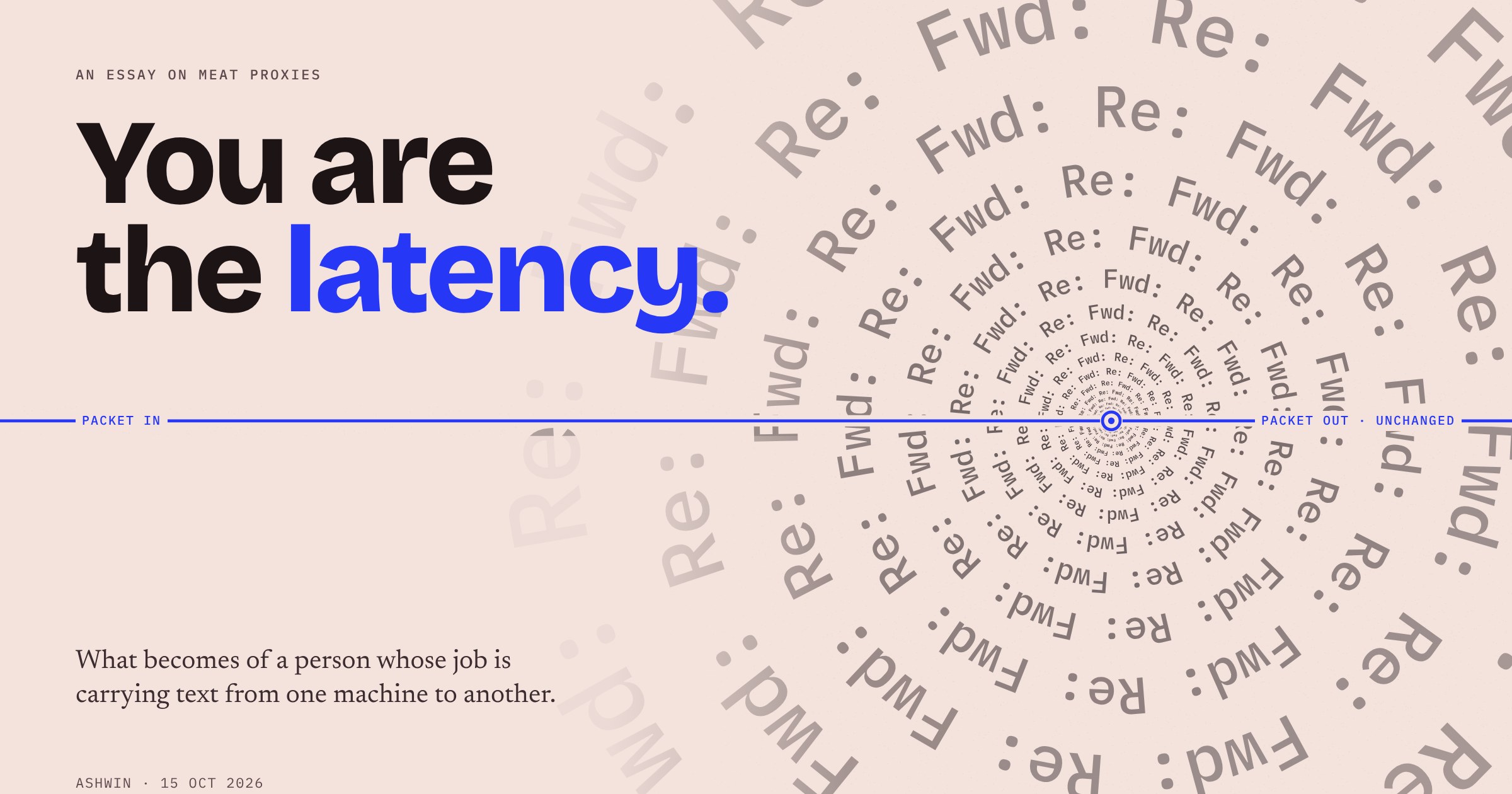
In August a developer named Niklas Gruhn wrote a short, irritated blog post with a title I would have killed for: Don’t be a meat proxy. A meat proxy is someone who takes what the AI said and hands it to you without reading it. His complaint fit in a breath. If you’re just going to paste the model’s answer at me, I could have asked the model myself. Faster, and I’d control the context. “I don’t need a meat proxy in between.”1
Simon Willison called it an excellent new term. Kottke posted the definition. Fast Company ran a sensible piece on how not to be one. Everybody nodded and went back to forwarding things.
Most of what got written treated it as etiquette. Read before you send. Rewrite it in your own words. All true, all fine, and none of it is the part that keeps me up. Etiquette is about the person receiving your paste. I’m more worried about the person doing the pasting. What happens to you, if this is what you do all day?
So I followed the packet. It goes further down than I expected.
$ traceroute "what she actually meant"
 1  her
 2  her model
 3  your inbox
 4  you                 * * *
 5  your model
 6  you                 * * *
 7  her model
 8  her                 "great, thanks!"
The email
You’ve seen this loop. You might be in one right now.
Your manager has half a thought. She asks a model to turn it into a proper request, and three neat paragraphs land in your inbox, with a bulleted list of “key considerations” that nobody considered. You skim it. You paste it into your model and ask for a reply. Four neat paragraphs go back. She pastes those into her model and asks for a summary, and the summary says you’re broadly aligned, with some caveats. She writes back “great, thanks!”
Two machines just had a meeting. Two people carried the paper. Nobody in the building could tell you what was agreed.
Every box a packet passes through on its way somewhere is a hop. Each one costs a little time, and network people put a lot of effort into cutting them down, because a hop that adds nothing is just delay. Latency.
That’s what a meat proxy is. Not lazy. Not evil. Latency.
And people get the fear backwards. Everyone’s scared AI will take their job. If your job is carrying text from one model to another, the AI already did the job. What’s coming for you is a cable. Cables are cheap and they don’t take lunch.
This isn’t just me being grumpy. In 2025 researchers from Stanford’s Social Media Lab and BetterUp Labs surveyed 1,150 desk workers in the US about something they called workslop: AI work that looks polished and has nothing inside. 40% had received some in the past month. Each one took close to two hours to deal with. About half of the people on the receiving end said they now saw the sender as less capable and less reliable.2
So the person you forwarded it to does the work you skipped, and then thinks less of you. They’re right on both counts.
The room
In 1980 the philosopher John Searle asked his readers to imagine him locked in a room. Batches of Chinese writing are handed in to him. He can’t read Chinese, but he has a rule book in English that tells him which symbols to hand back out. He gets so good at it that the people outside think there’s a fluent speaker in there.
“As far as the Chinese is concerned, I simply behave like a computer. … I do not understand a word of the Chinese stories.”3
Searle built that room to argue that a computer following rules doesn’t understand anything. Philosophers fought about it for forty years. The question was always whether the room understood. Nobody worried much about the man.
Well. The rule book writes its own paragraphs now. And the man is still in there, passing pages back out. Except now he has a job title and a quarterly review, and he went in voluntarily.
Searle had to imagine that room. We built it and moved in.
The Turk
In 1770 Wolfgang von Kempelen showed the Habsburg court in Vienna a machine that played chess. A carved figure in a turban sat behind a cabinet full of gears, and it beat people. It toured for decades. Napoleon is said to have played it. So is Benjamin Franklin. It was a fake, obviously. A human chess master sat folded up inside the cabinet, moving the pieces from underneath. Edgar Allan Poe wrote an essay in 1836 trying to work out where the poor man was crammed. The Turk burned in a Philadelphia fire in 1854.4
In 2005 Amazon launched a service where companies pay people small amounts to do the little tasks computers couldn’t do yet, and named it Mechanical Turk. Jeff Bezos called it artificial artificial intelligence. People hidden inside an API, pretending to be the machine.
In 2023 three researchers at EPFL paid workers on Mechanical Turk to summarise research abstracts. Using keystroke data and a classifier, they estimated that 33 to 46 percent of them had quietly used a language model to do it. They called the paper Artificial Artificial Artificial Intelligence.5
Say it out loud, it’s worth it. A person hidden inside a machine. Then people hidden inside a service, pretending to be a machine. Then a machine hidden inside the people hidden inside the service pretending to be a machine.
This July, Amazon stopped taking new customers for Mechanical Turk.6 I’m not claiming the two are connected. I’m saying look at the shape of it.
The meat proxy is the next turn of the same spiral. A model, hidden inside a person, pretending to be a person. And the man inside von Kempelen’s cabinet could at least play chess.
The alibi
Stanley Milgram spent the early sixties getting ordinary people to give what they believed were painful, dangerous electric shocks to a stranger, because a man in a grey lab coat told them the experiment required it. In his 1974 book he explained it with something he called the agentic state, where a person “comes to view himself as the instrument for carrying out another person’s wishes” and stops feeling responsible for what his own hands are doing.7
Psychologists have argued with that explanation ever since, and some of the arguments are good. I don’t need the theory to be perfect. I’ve heard the sentences.
The AI said. That’s what ChatGPT came back with. Claude suggested we do it this way.
Listen to the grammar. The model is the subject of the sentence and the person has quietly stepped out of it. Nobody says “I decided.”
This is the bit that actually makes me angry. Not the laziness, I get the laziness, everyone’s tired. It’s the alibi. When the forwarded thing turns out to be wrong, and plenty of it will, the meat proxy has their excuse printed and laminated already. Wasn’t me. I just passed it on.
“Don’t shoot the messenger” was always a bit of a dodge. Now everybody wants to be the messenger.
The skill
In 1983 a British psychologist named Lisanne Bainbridge published a five page paper called Ironies of Automation. She was writing about control rooms and cockpits, not chatbots, and she still described us better than most of what gets written today.
“By taking away the easy parts of his task, automation can make the difficult parts of the human operator’s task more difficult.”8
The machine does the routine work. The human is left with only the strange cases, and without the daily practice that would have prepared them for strange cases. “Physical skills deteriorate when they are not used,” she wrote. So does thinking.
Forty two years later a team from Microsoft Research and Carnegie Mellon surveyed 319 knowledge workers about 936 real tasks they’d used generative AI for. They cite Bainbridge in their introduction, and then more or less back her up: “higher confidence in GenAI is associated with less critical thinking.”9 The more you trust it, the less you check. The less you check, the less you can.
Then there’s the MIT Media Lab study that got shared everywhere last year. It’s small, 54 people, not peer reviewed, and the headlines oversold it badly, so hold it loosely. But one number stuck with me. 83% of the people who wrote an essay with ChatGPT couldn’t correctly quote a single sentence of it afterwards. In the groups that used a search engine or nothing at all, it was 11%.10
They didn’t forget their essays. They never had them. The words went through them the way current goes through a wire.
The last hop
This is where the spiral ends, and it’s the part I like least.
The last proxy isn’t between you and your manager. It’s between you and you.
You get half a thought in the shower. Before it’s even finished you’ve typed it into a model and asked it what you think. It tells you, in bullet points, nicely balanced. You nod. That’s your opinion now. You never held the original long enough to find out if it was better, or stupider, or the one interesting idea you were going to have this month.
Leslie Lamport, who won a Turing Award for his work on how computers agree with each other, has a line I think about too much: “If you’re thinking without writing, you only think you’re thinking.”11 I keep wondering what he’d make of people who aren’t doing either.
So
I’m not telling you to stop using these things. I work with them every day. I’d be a hypocrite, and a slow one.
I’m telling you that in any loop, the one part you can’t optimise away is the part that decides. The part that reads it, cuts half of it, changes its mind, signs it, and is wrong in public with its own name on it. Be that part. It’s the only job in the loop that isn’t a wire.
A test, and it’s cheap. Before you send anything a model wrote, ask yourself:
What did I change, and why?
If the answer is nothing, don’t send it. Send the prompt instead. It’s shorter, it’s honest, and they can run it themselves.
Otherwise you’re a hop. And sooner or later somebody notices the latency.
Ashwin · Bengaluru
I build ThruLine, which keeps a record of what coding agents actually ran, so the person at the end of the loop can check before they sign.